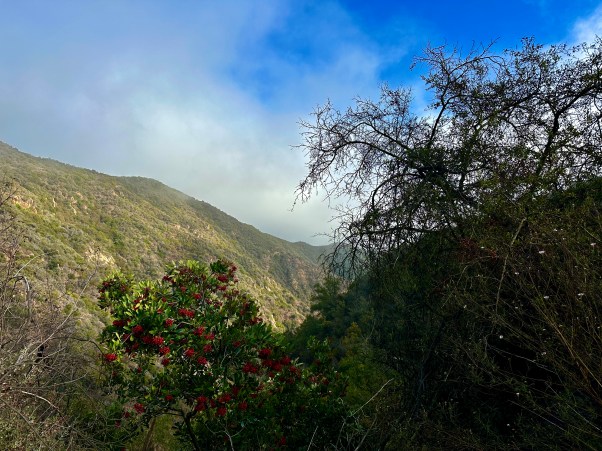
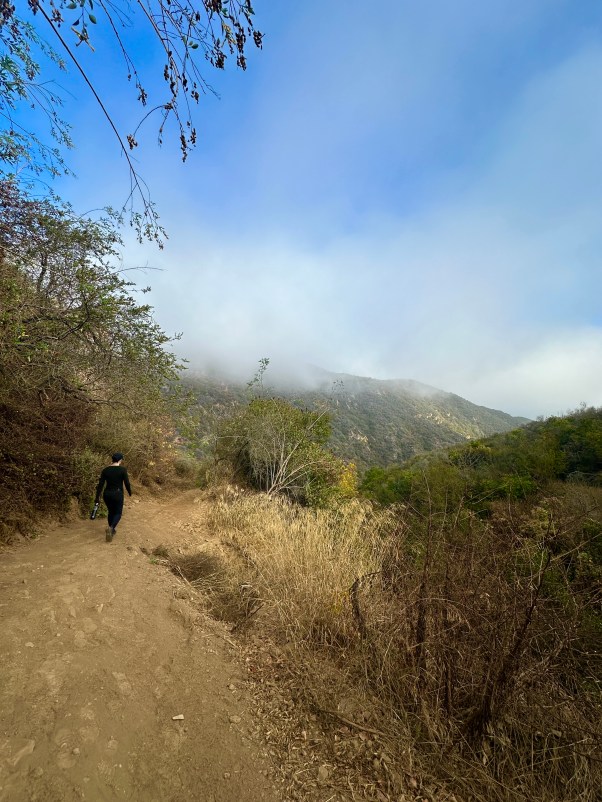
On Christmas Eve my daughter and I hiked through Temescal Canyon Park in the Pacific Palisades during what started as a rainy and misty afternoon. The landscape was dusty and dry but uplifting and breathtaking. We walked mostly in silence, taking in the bird song and rustling wind. Being in her familiar terrain, she led and I followed. One can easily feel the history in this labyrinth of old trails which traverse for miles and open to expansive ocean vistas. On this particular day our view was curtailed by low clouds blowing around us but we were grateful to be in such beauty all the same. In the end the sky opened briefly to a brilliant blue.
Since Tuesday this area and several others have been ravaged by wildfire and will be forever changed. As of today, the LA Times reported at least five people have died, more than 2,000 structures have burned and at least 130,000 residents are under evacuation orders due to the fires raging across Los Angeles County. The Palisades Fire is “one of the most destructive natural disasters in the history of Los Angeles” and as I write is still spreading. Containment is unknown. Beyond prayers, which are always needed in such horrific times, donations can be made to a number of organizations found here.
Although the cause of the wildfire is yet unknown, this Santa Ana wind is spreading the flames at an alarming rate. “It is hard for people who have not lived in Los Angeles to realize how radically the Santa Ana figures in the local imagination. The city burning is Los Angeles’s deepest image of itself. Nathaniel West perceived that, in The Day of the Locust, and at the time of the 1965 Watts riots what struck the imagination most indelibly were the fires. For days one could drive the Harbor Freeway and see the city on fire, just as we had always known it would be in the end. Los Angeles weather is the weather of catastrophe, of apocalypse, and, just as the reliably long and bitter winters of New England determine the way life is lived there, so the violence and the unpredictability of the Santa Ana affect the entire quality of life in Los Angeles, accentuate its impermanence, its unreliability. The winds shows us how close to the edge we are.” “The Santa Anas,” Joan Didion in Slouching Towards Bethlehem, 1969.

“There was a desert wind blowing that night,” Raymond Chandler writes in the famous opening to his novella Red Wind. “It was one of those hot dry Santa Anas that come down through the mountain passes and curl your hair and make your nerves jump and your skin itch. On nights like that every booze party ends in a fight. Meek little wives feel the edge of the carving knife and study their husbands’ necks” (LA Times). This fictional metaphor feels exactly how this wind feels, murderous.
In the midst of this overwhelming disaster I am reminded that while nature can be swift and cruel, people can be equally generous and kind. If you have the means to help, please do so here. If you or anyone you know are affected by these wildfires, here is a list for immediate aid: Resources for SoCal fire victims, evacuees and first responders Also the LA Food Bank site is an excellent place to find aid or to donate.
 Nine Cent Girl
Be safe, Moira. Yikes. Thanks for the links. I know many folks down there who are, for now, safe. But who knows? None of us will escape climate change and the horrors it brings. I fear it’s only just beginning. 😦
LikeLiked by 1 person
💔
LikeLike
❤
LikeLiked by 1 person
I wish our tears could diminish the flames. Stay safe! Thank you for the donation resources.
LikeLiked by 1 person
Thank you for your kindness
LikeLike
I don’t watch the news, but on Facebook there are lots of video clips of the fires and the destruction. It’s just horrific! I was just there in September. Hopefully you and your family are safe.
LikeLiked by 1 person
Thank you for the good wishes! Beware of FB videos and information— it is rarely accurate— but the good will of people is extraordinary 🤍
LikeLiked by 1 person
yes close to the edge
LikeLiked by 1 person