Irony interests and excites every AP English Literature teacher I know. The defying of expectation in character or plot, the twists of deception, the nuance of regret, the way shadows fall against the backdrop of romance, each singular thread pulled to create the tapestry within a novel, play or poem is what we feed upon from August to May, what we present to those hopeful students who plod through Dostoevsky and gasp over Miller, who acknowledge the majesty of Woolf and Ellison alike irregardless of their divergent settings. This week I ushered my students, those brave souls willing to sit for three hours of an exam to sift through metaphor and imagery and opposition and unlock both literal and emotional meaning and then craft their own response to texts. It is a lot to ask of anyone. I tell them I love them as I leave them under their proctor’s watch, and in that moment, I am so proud of their resolve to crack open this test and shine onward, for they are readers, now a rarity residing in our republic.
Tag Archives: AP English Literature
hold on to hope
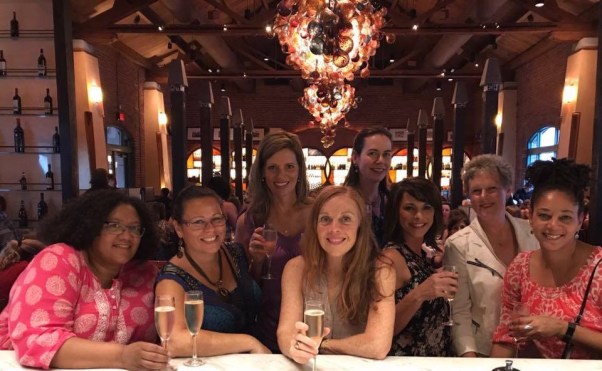
In this time marked by the disintegration of morality in our politically frayed America, where hateful politicians posing as caring humans justify their inhumane practices by treating children with the cold abuse of a Nazi, we must hold on to hope. That fragile and slender of emotions that alone fuels my soul, and no doubt yours, hope, elusive yet necessary. Thankfully for me, this past week, there is the reminder, where there is love one can find hope. Of course there is the always love of family, of sunshine and water, of a cool breeze after a hard day, but in this crazy here and now, I find the love of these friends. Friends who arrived from luck yet stayed dear through the years. Without a falter, these women are there. Yes, lucky me indeed. They provide me hope to endure.
Starry Nights
As I embark on a Shakespeare unit with my students, nine graders reading Romeo & Juliet and AP Lit reading Hamlet, we start with questions. Questions Elizabethan thinkers might have pondered in 1598; questions we still ponder in 2018. I am struck with our timeless preoccupation over destiny: Are we the masters of our own fate? I ask students to think and write about their beliefs on this topic. Certainly, these teens, like those penned by Shakespeare, want to believe they are, indeed, in control of their outcomes, while I, I who have screamed up at the Heavens in distress, frustrated by the unpredictability of chance, those ‘why me’ moments; “O, I am Fortune’s fool” situations. As if we are pulled by strings invisible to our own hands. Just when we want/need/hope for a different outcome we must settle for what is… but as I look across the classroom at my students, into their hopeful eyes, their exuberant optimism, I see their uniform belief that yes, they are masters of their fate. They aren’t phased by headlines or politicians’ lies; they see their own trajectory as it slants up and beyond, straight into the starry night. Straight into heaven.