Recently we spent an afternoon in Joshua Tree National Park as a reconnaissance for a longer road trip we hope to do next Fall, and wow, the whole experience was just hours of WOW. Not as hot as we expected and far more beautiful. We discovered a variety of vegetation and land forms under a blue blue sky and a sandy vast earth below. Needless to say, we were quite taken by all of the park. This post is only a first impression, laced with some factual information. The desert gaze is everything fabulous, so yes, please, come wander along with me.
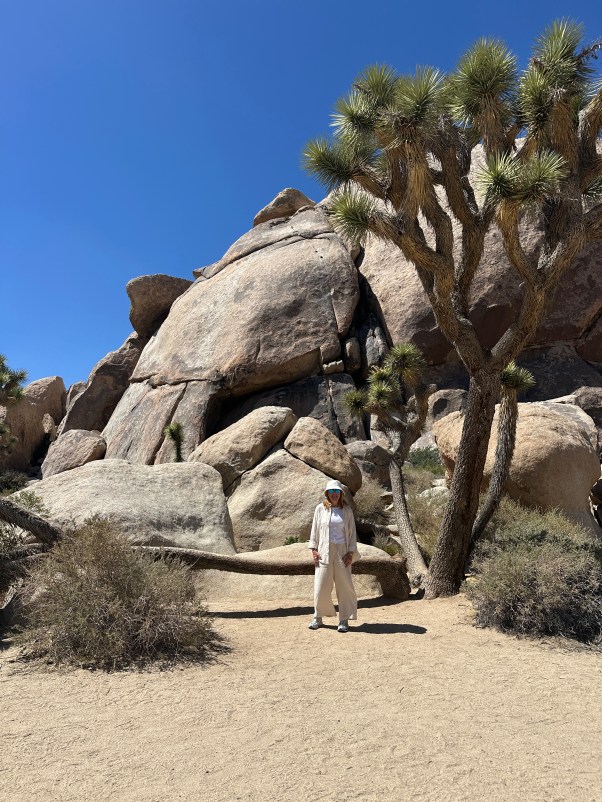
To start, here’s a list of several random facts from the website I found interesting:
Joshua Tree National Park encompasses lands where the Mojave and Colorado deserts meet. Much of its nearly 800,00 acres are designated as wilderness. The diverse landscape supports varied ecologies, including plant communities and landforms from low basins to mountain ranges.
The Joshua tree forest in the northwestern portion of the park covers the 4,000-foot-high valleys of the Little San Bernardino Mountains. Some valleys have plants found nowhere else on earth.
Desert basins in the eastern portion of the park can sink below 2,000 feet and summer temperatures may reach 120°F. Creosote, ocotillo, and cholla cacti dominate, and Joshua trees are not present.
Projectile points found along an extinct water channel in the Pinto Basin represent the earliest known human occupation of this area. Dated from four to eight thousand years ago, this Pinto culture was first described by amateur archeologists, William and Elizabeth Campbell in the 1930s.
While the Joshua Tree area has been inhabited by humans for at least 10,000 years, by the late 1920s the development of new roads into the desert had brought an influx of land developers and cactus poachers. Minerva Hoyt, a Pasadena resident who was extremely fond of desert plants, became concerned about the removal of cacti and other plants to the gardens of Los Angeles. Her tireless efforts to protect this area culminated in 825,000 acres being set aside as Joshua Tree National Monument in 1936.
Mining and ranching changed how people used the land around Joshua Tree. The California Gold Rush and successful cattle ranching made the southwest deserts more appealing. Beginning in the 1870s, gold miners came to the rocky hills around Twentynine Palms, while ranchers used the highlands for spring grazing and built water catchments called “tanks” to capture water for the cattle.
The arrival of new groups deeply impacted Native American communities, cutting them off from their traditional food resources, water sources, and place-based culture. Pressured to leave traditional collecting and travel areas for nearby designated reservation lands, Serrano, Cahuilla, Chemehuevi, and Mojave communities lost access to traditional resources outside of these designated areas. Some tribal members adapted by working for early prospectors or were hired as farm hands and cowboys.
Joshua Tree provides habitat for 813 higher plant species, 46 reptile species, 57 mammal species, and over 250 bird species.
Park staff maintain 93 miles of paved roads and 106 miles of unpaved roads, nine campgrounds with 523 campsites and two horse-camps, and 10 picnic areas with 38 picnic sites. There are 32 trailheads and 191 miles of hiking trails throughout the park.
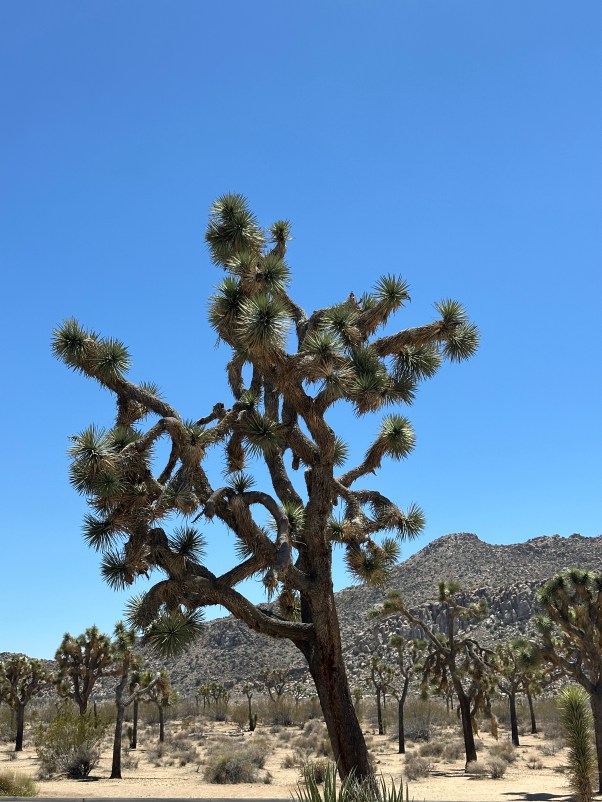
The Joshua Tree, so named by the Mormons, does feel sacred, with its branches reaching upward to the heavens, but the trees also feel lighthearted, even comical. One could assume Dr. Seuss devised much of his imagined world from such an unique species in this strange land.
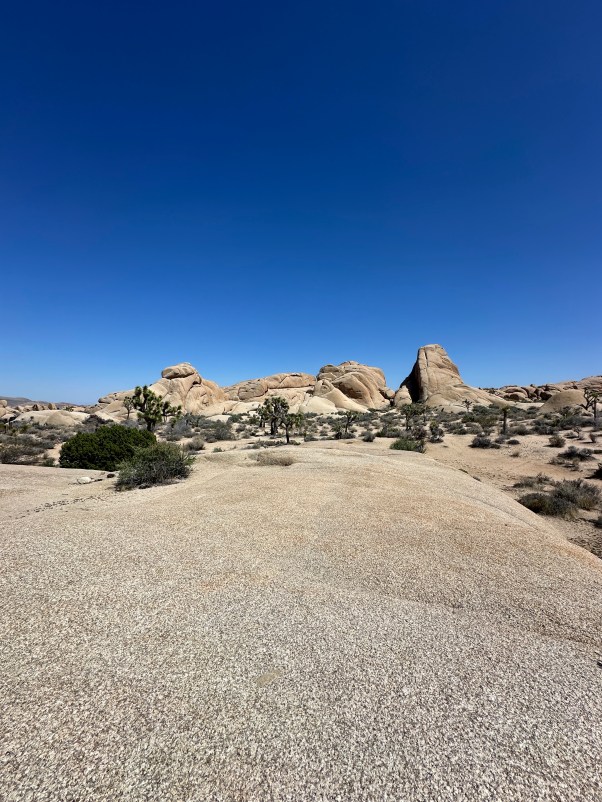
The rock formations really struck us. We hopped out of the car to traipse about these geological formations all afternoon, each one more exciting than the last. We left our question about how were these created until afterwards to just feel the awe of the place for which I am glad. Hours of awe feels like the perfect response.
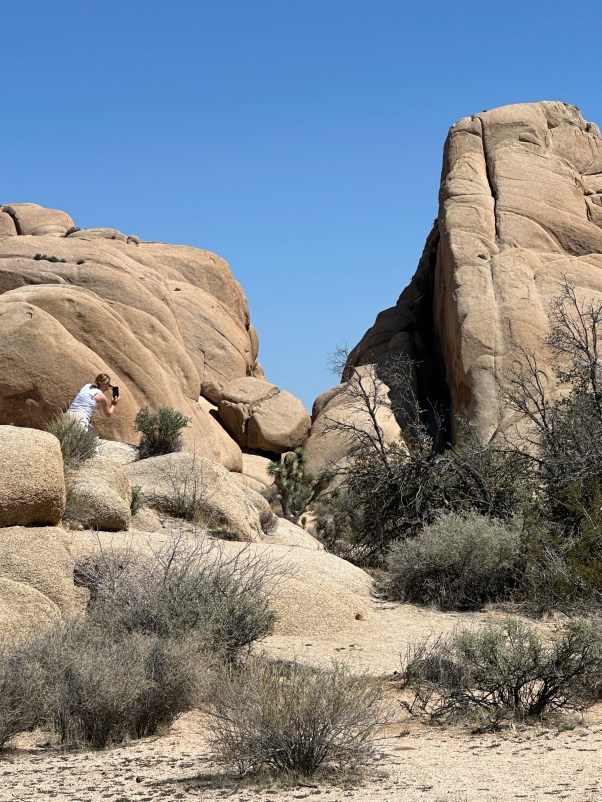
Although we did not stay long enough to experience the night sky during our visit, there are plenty of reasons to do so, starting and ending with the stars, planets and meteors, especially now that where most of us live is too bright to see them. Stargazing is a main attraction in Joshua Tree, with the Milky Way in full display on moonless nights. The Sunset Stroll is another activity on our next visit list.

As we wandered the sandy paths we also discovered the extraordinary greenish yellow cactus blooms, delicate and airy among a most unforgiving sea of thorns.

Skull Rock is just one of the many named rock formations in the park. As I scrambled about to find the best angle I heard another park visitor say it looked like a skull drawn by a 10 year old. Hard to disagree, but also pretty daunting to recognize what wind and water can do to granite over thousands of years.

In the southern part of the park we found the Cactus Garden, filled with teddy-bear cholla, (quite an ironic name), which are also native to this area. These cacti were flowering too and caused us to stand still in adoration for a while. Although Do not touch signs were posted, one might find that quite unnecessary as the cholla are a spiky and barbed plant: cute but not hospitable to the touch.

Our last discovery was the Ocotillo, also indigenous to the area, and also blooming on our lucky visit. These plants are covered in thorns, and will regenerate their leaves after rainfalls. We stood next to several that are probably close to 100 years old because they were over 10 feet tall. In this magical place one could imagine days gone by when the Serrano, Chemehuevi and Cahuilla peopled this distinctive desert with pride and purpose.

There is no doubt that California has something profound to discover in every direction from every starting point. There is no doubt that we will do our best to wander freely whenever we can to experience such unique and varied treasures.

 Nine Cent Girl
Such a magical place! 💕
LikeLiked by 1 person
Absolutely 💯!
LikeLiked by 1 person
The landscape is breathtaking, but those gorgeous blue skies are something else, too!
LikeLiked by 1 person
Right?!?! So brilliant!
LikeLiked by 1 person
Beautiful photos and love the place!
LikeLiked by 1 person
Thank you 😊
LikeLike
Looks like a perfect adventure location.
LikeLiked by 1 person
Yes— the desert is quite foreign to us— but so lovely!
LikeLiked by 1 person
Wow ! Wonderful place! Well shared with beautiful photos and description. Thank you 😊👍🏼
LikeLiked by 1 person
Thanks for letting me know! It is spectacular— so unique!
LikeLiked by 1 person
Welcome 🤗 Hi visit my YouTube channel 🙂.https://youtube.com/@pritilatanandi2010?si=U6DiYBhaqXq-yDxS. If possible then subscribe to it. IT will be my pleasure 😊 thank you 😊 stay blessed 🙏🏼
LikeLiked by 1 person
What a fabulous walk! Beautiful photos to share. 🙂
LikeLiked by 1 person
Thank you for strolling with me! 🌵
LikeLiked by 1 person
Such a vast expanse of desert, so many spectacular rock formations, … and those gorgeous azure blue skies, … and skull rock… it actually looks like it’s been carved, …it looks as if you’re walking in the land of giants, … & an amazing location to visit. …💫
LikeLiked by 1 person
Right?!? We can’t wait to go back… so extraordinary 💯
LikeLiked by 1 person
Cool place! Thanks for bringing me back…..bye. Kamila
LikeLike
Beautiful pictures 🖼️
LikeLike